Saturday, December 22, 2007

"Coffee" - Poem For the People of Acteal, Chiapas, Dec. 22, 1997

In honor of the massacred at Acteal 10 years ago, here is an early version of my poem, "Coffee" - May there be peace with justice and dignity for all.
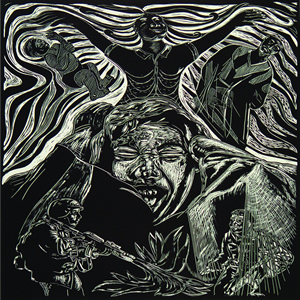
René Arceo -
Linocut by Rene Arceo

---------------------------------
Coffee


I.

In Guatemala the black buzzard
has replaced the quetzal
as the national bird. The shadow
of a man glides across the countryside,
over the deforested plantations; a death
cross burnishes history into myth
as it scours the medicinal land into coffee;
burial mounds that could be sites
of unexcavated knowledge hold only
blasted feathers and the molding bones
of freedom. Golden epaulets glint
in the fluorescent offices, crystal
skulls shine in the eyes of the man
with the machete, within the site
of an AK-47. Under the rubble
of the ruling class, a human heart
beats in the palm, the tumba of ritual mercy
drums in the thunder clap, a hurricane wind
sounds the concha. In Quetzaltenango, foreign
interests plot the futures of Mayan hands
and Incan gold. While on Wall Street,
the black sludge of a people trickles through
cappuccino machines like hissing snakes.


II.

Acteal. December 22, 1997. Bloodied
mud sucks the plastic sandals of a child,
velas gutter through the saged prayers
in the little church blasted through with
twenty-two splintered holes the size
of a baby's tender fists. Melon heads pop
and the hacking drum of a machete
meeting bone counts down the hours
of matanza. Somewhere, a telephone
rings off the hook. The Vicar of the Diocese
calls in twenty minute intervals. 140 federales
stand smoking in the twilight, at their feet,
the trampled harvest of peasants gleams
through the saturated leaves. Homero
Tovilla Cristiani picks up the phone: "I have
notified General Jorge Gamboa Solis. Everything
is under control. There is no massacre in Acteal".
He places the receiver again off the cradle
on the well-ordered desk. Meanwhile, a young
Tzotzil bloodies her knuckles scratching a hole
in the adobed wall of a cave feathered with Jaguar,
fur where 14 women and children wait,
shivering in the dark. An infant picks up the call.
The first woman in line gazes into the coked-up eyes
of her assassin projecting his automatic weapon
into the ear of the whimpering baby at her breast.
500 years of history gets written in her eyes, as a Tzotzil
mother wedges her sleeping newborn into the hole.
She spits on the reddening dirt, and covers
her luz like a cat. Forty five pair of shoes
get lost in Acteal. Matted hair clings
to the coffee plants, each green leaf,
another listening ear; each red seed,
another eye, dislodged from its skull. I hear
nothing happened in Acteal. And if it did
no one knows who they were. The PRI
press machine stands on the ridge
of Destiny, staring Truth in the eye
as men lie to the cameras. Twenty yards
away, the survivors are speaking
the names of the men paid 600 dollars
American. Men with no families but a spoon
and a copa. Men with no names but the trademarks
emblazoned across their chests and on their running shoes.
I hear forty-five graves being dug today.
The women form a chain of hearts.
They have dried the earth baked with their tears.
Each one carries a red mud brick
from the killing floor where the people
were hacked into pieces the size of a bat.
Here, the "Bat People," Tzotziles, will
build a house for their dead, and pray.


III.


Alonso Vázquez Gómez
María Luna Méndez
Rosa Vázquez Luna
Veronica Vázquez Luna
Mícaela Vázquez Luna
Juana Vázquez Luna
Juana Luna Vázquez
María Jímenez Luna
Susana Jímenez Luna
Miguel Jímenez Pérez
Marcela Luna Ruíz
Alejandro Luna Ruíz
Jaime Luna Ruíz
Regina Luna Pérez
Roselia Luna Pérez
Ignacio Pukuj Luna
Mícaela Pukuj Luna
Victorio Vázquez Gómez
Augustín Gómez Ruíz
Juana Pérez Pérez
Juan Carlos Luna Pérez
Marcela Vázquez Vázquez
Antonia Vázquez Vázquez
Lorenzo Gómez Pérez
Veronica Pérez Oyalte
Sebastian Gómez Pérez
Daniel Gómez Pérez
Pablina Hernández Vázquez
Rosela Gómez Hernández
Graciela Gómez Hernández
Guadalupe Gómez Hernández
María Ruíz Oyalte
Catalina Vázquez Pérez
Catalina Luna Ruíz
Manuela Paciéncia Moreno
Margarito Gómez Paciéncia
Rosa Gómez Pérez
Doida Ruíz Gómez
Augustín Ruíz Gómez
Rosa Pérez Pérez
Manuel Vázquez Pérez
Juana Vázquez Pérez
Josefa Vázquez Pérez
Marcela Capote Vázquez
Marcela Capote Ruíz


We are One Spirit, One Heart and One Mind.


IV.


Marseilles. Summer of 1940.
In the Cafe Rue d' Bohéme, a poet,
Hans Sahl, sits waiting for someone
to buy him a cup of coffee in exchange
for witty repartee. He is a dead man.
His name has appeared on a list of German
refugees commanded to "Surrender on Demand."
He is convinced he will never leave France
except by cattle car. A compatriot tells him
an American was asking for him by name,
that "Varian Fry is now waiting" for him at the
Hotel Splendide "with money and an emergency
visa." He thinks the man is crazy or
it is a joke crueler than fate for a Jew.
He sits in the Cafe all day, writing his last poems
on the coffee splotched napkins. He writes:

Sprich


Not to lost causes present your heart.
Nor love those who cast you from their midst.
Forget dark visions your dreams impart.
Forget the hand that pushed you into emptiness.

Let not phantom sounds tear you apart
That yesterday's world brings to your ear.
Not to lost causes present your heart.
Guard yourself until your hour's here.

He empties the bitter cups of coffee, knowing
they are the last he will ever taste in unoccupied
France. That fall, he sits in a Greenwich Village
cafe, the cooling coffee sweetened with the blood
of the funny little man who brushed in the stamp
on his forged exit visa. He vows to spend the rest
of his days praising the man who defied the orders
of nations, Nazis, industry, collaborators,
gendarmes, and the United States Consulate.


V.


Work is the refuge of sadness.
"Only when we remember does sadness
overcome us and we cry. It's better
to just keep busy," says María Ruíz.
The women knead the masa under the heels
of their hands, cupping the balls of cornmeal
pocked with a few black beans. They pat
the bolas into palm-sized portions: golden
ears of corn, black eyes of frijol, red tongues
of chili. On December 23rd there is laughter
in Polhó. The señoritas giggle at the gringo's
questions. "Qué tiene? Qué tiene?" Meaning
What is inside this humble feast they are
preparing for the ones who have come with
provisions and witness? "What's the matter?"
"Qué tiene?" The gringo insists. They smile,
a coy reply. "Nada." Nada. There is nothing
in Acteal. The federales have stolen the well-packed
sacks of coffee, a year's hard labor. They have
torn-up the clothing, peed on the grain, slaughtered
the animals, taken radios, cooking pots, weaving,
looms. The same soldiers who shit in the kitchen
now sport yellow arm bands reading Labor Social.
Work is the refuge of sadness.
Work is more than the sum of a job.
"We need to finish off the seed!"
Mícaela heard them shout.
She had been praying in the chapel since six.
At eleven she heard the gunfire start.
Men and women were on their knees.
Some stood up and began to run. Some fell
in the chapel. The only way out was the steep
embankment. Her mother took her by the hand
and carried the two youngest. The bullet
entered her mother's back. They were found
by the children's cries. First they shot her
mother, then the babies. She made no sound
under her mother's cooling huipil. "Diego,
Antonio y Pedro. More than fifty from Los Chorros,
Pechiquíl, La Esperanza, Acteal. They were dressed
in black. The ones in charge had military uniforms."
She testifies to the National Human Rights Commission.
She testifies to anyone who works to listen. How they
stripped the dead women and sliced their breasts,
forced sticks between their legs, opened the wombs,
passing the fetuses from machete to machete....
Where once she worked to silence her siblings,
at 11, Mícaela's work is to be the mouth
of a people. Behind each of the names
is a life, lost between the reporter's lines
and the photograph's caption.


VI.


"No more genocide in my name. . . ."
A young girl in trenzas sings outside
The Mexican Consulate in Denver.
"Go back to where you came from!"
shouts a car of gringos speeding down
memory lane, and are nearly drowned out
by the ritual drums and the Native chants.
First World faces sing out above the placards
like severed heads or scalps. "No more Genocide . . ."
. . . in Guatemala, Colombia, El Salvador, Chile,
Sand Creek, Wounded Knee . . . . Not with arms.
Not with training. Not with money. No more
of my tax dollars to buy the man who drives
the Humvee that transports the soldier who shoots
the bullet that blinds the toddler, that enters the heart
of Guadalupe López Méndez who dies in Ocosingo
asserting her civil rights. No more Genocide
in my name. We shall not overcome. We shall fight
this way forever. Estas son mis armas:
la computadora, el video, la pluma.
La plumage de justicia hangs from the broken
arrows of palabras breaking the media block
of Truth and Consequences of Free Trade Agreements.
Horrific to read, to imagine, to know, to tell ..
but the only end to bullets for profit is knowledge ..
knowledge that will not appear wedged between
commercials for Taster's Choice and
Nobody Doesn't Like Sara Lee like the living body
of an indigenous child found two days after a massacre
in a bullet-ridden cave. Is this any way to fight
a drug war? Coffee, sugar, chocolate,
cattle. . . . "N . . . É . . . S . . . T . . . L . . . E . . . S . . .
Néstles makes the very best . . . MUR . . . DER!"
310 kilos of cocaine are found in Mazatán,
the municipality where the governor, Julio César
Ruíz Ferro, has two large mansions, a ranch
with a hundred hectare banana plantation and
is building a luxury hotel with 100 suites, underground
parking, boat dock, restaurant, bar and disco.
Revenue from taxing an impoverished indigenous
population was good this year. Meanwhile,
the Mexican Red Cross sends contaminated
and expired drugs to the thousands of refugees
dying of exposure, pneumonia, and other infections
in the frigid mountains. "Néstles makes the very best . . .
MUR . . . DER!" 15 billion served, ground flesh
for the masses. I will grind Zapatista coffee
with the tongues of witness. I will wear
the huipil and honor the mothers. I will write
the dark into dawn. I will sit in the offices,
shut down the lying dog press, picket
the congress into action. I will not bank
with assassins. I will buy crafts, not Kraft,
Néstles, Proctor & Gamble, McDonald's, Sara Lee. . . .
I will fight this way forever. Estas son mis armas:
la computadora, el video, la pluma.
"A culture isn't vanquished until the hearts
of its mothers are lying on the ground."
I will fight this way forever: I will say.
I will fight this way forever: I will pay.
I will fight this way forever: I will pray.
Amen. Y Con Safos.


Lorna Dee Cervantes

El Cinco de Mayo, 1998

Labels: , , , , ,

Saturday, December 08, 2007

Life and Death On the Border - Interview with Poet/ Photographer, Francisco Dominguez

“Life and Death On the Border: An Interview With Francisco Dominguez” by Danielle Fodor
Broadcast on “Sparkplug,” Free Radio KDRT, January 11, 2006, in Davis, CA

http://media.libsyn.com/media/sparkplug/francisco2.2.mp3


D: Francisco Dominguez is an artist, activist, teacher, and documentary photographer as well as a friend. And today he will be talking about the project he's been working on for over a year now called “The US/ Mexico Border: Documenting Life and Death Along the Border.”

I guess I want to start out by asking you, how did you get started on this project?

F: Well, I've been documenting farmworkers here in California since around 1989. Actually, my father came here on the Bracero Program from Mexico City in the late 1940's to work. And the Bracero Program was a program set up by the U.S. Government to bring in workers from Mexico because of the shortage of labor after World War II, for people to work in the agricultural industry here in California. So, my father did farm labor work, and also my mother, who grew up in Abeline, Texas, they used to work in agriculture too. They grew cotton around that area. They used to pick cotton in Abeline in their youth. So then also, growing up in Sacramento we used to, me and my friends, we'd always go work in the pears along the Sacramento River in Cortland every summer. That was our way of making some extra cash, to go work in the pears. Yeah, we were the “Pear Guys.” I've been around, you know, that type of work most of my life. And so, naturally, I had an interest in that. And as a photographer I started documenting the farmworkers. And when you do that you start looking into a lot of labor abuse, pesticide abuse, pesticide poisoning within the workers, racism, sexism, you name it, it's out there, because a lot of the workers are undocumented and so they are basically targets of this type of a behavior because they can't complain to anybody with these types of abuses. They're living in fear. When you don't... when you're not documented you're not going to go to officials and talk about these type of things. So, that's part of my background. And just wanting to uncover some of the things that are happening that are out there. That's always been my goal. Also, for education. And as a photographer, to give a face to the worker, to give a face, a human face to the farmworker to the public. Because that's something we don't see. We go to the store, we see the apples and the cabbage, carrots, walnuts, but we don't see those faces that pick it. So that's been my goal - is to show that.

D: My next question then is, how do you change from documenting farmworkers who were here working in fields to documenting the border?

F: Well, two years ago I was spending some time in Mexico in Oaxaca and I ran into an artist friend of mine, his name is Alejandro Santiago who's one of the major artists of Oaxaca, actually all of Mexico, and he was doing a migrant project, and he was doing ceramic figures of native Oaxacans who are leaving Mexico to go work in the United States. Actually there are whole ghost towns now in southern Mexico, in Oaxaca, where because of NAFTA, because of policies of the Mexican government, people are leaving because they cannot compete with the corporations, the multinationals that are coming in and are setting up farms there. They can't survive as small farmers so there's a massive exodus to the United States of workers. Just since 1994, it's been estimated there's five million workers that have come into the United States from Mexico—undocumented workers. And probably out of those five million at least one million indigenous people from Mexico. So you're seeing huge numbers. And he told me he was going to have some shows. He's going to show these because he shows on the ceramic figures the physical and psychological abuse these people go through to leave their country to go work in a foreign country, dealing with a racist society, the loss of their culture, the acculturation of their kids here to go to school, to be part of the “American” culture. A lot of these people come from tribes, and it's actually very destructive on their own tribal culture, their own ceremonies, because once people come here, once, if they go back they don't really want to be involved in that. So, he's looking at the loss of their culture, the destruction. And so he, uh, well, I showed him some of my farmworker pictures. I'm a photographer, so I had some of my work. He said, “Well, we're going to work together in the future because people need to..., because you're..., what you're doing is the end product of the exodus. What people are doing.” So I started documenting workers here in San Francisco. Because now labor, with Mexican labor, people are doing everything, from roofers, cement workers, bus boys, you name it, nannies, maids, everything. So I started documenting that. And then three years ago I started going, taking trips down to the border. The first trip was down in Douglas, Arizona. Then into Sausabay which is underneath Tucson, and we went down into Altar which is 80 miles from the Mexican border. It's like the main launching point for undocumenteds coming into the country from all over Mexico. It's this little town of 1,500 people but it's the major launching point, so we went down in there. We did some photography, some interviews, volunteered at a migrant center with the Catholic church. Then we came back and actually did a ride-along with the Border Patrol in Douglas. So I got to see that aspect. They took us to the jail. They showed us everything. It was pretty amazing. And then we met with some groups in Tucscon, some from Derechos Humanos group, then some from the Methodist church. And they go out and take barrels of water out to the desert. And they put these flags, these blue flags on them that are about 20 feet tall so that when people are going through the desert they can see those flags and know they can get water. Because the temperature average is over a hundred, you know, 110, 120 out there. It's a brutal heat in the summer, even in the springtime. So what is happening with the situation now, because they're building more fences and beefing up the patrols, so they're going to the most treacherous parts to cross, the most desolate,
and we're seeing an increasing number of people dying. Actually, the number has been going up every year, since, like, ten years now, but this year was the highest. I think it's up to 400 in 2005, I think the number was 485 people they found dead this year. And it's interesting because you would think because they pretty much doubled the amount of Border Patrol agents on the border, put more electronic devices, video cameras, you would think there would be fewer deaths, but actually the number is going up.

D: Now, I don't understand that, because, for me, it makes sense that there would be more deaths. The reason why is that as the border becomes increasingly militarized and these physicals barriers are built, and the walls are raised, people are going into more and more extreme areas in order to evade being caught. So it seems to me that would be a direct cause of an increase in deaths. The other thing I wonder is, how many deaths are actually occurring, because if people are going through more and more desolate areas in order to cross the border, I'm guessing that a lot of these bodies aren't being found.

F: Right. Yeah. Like this number from this year, 480, that's just the bodies they have found. And, because it's in the wilderness a lot of animals get a hold of the bodies and the bones are spread, and the buzzards.... Yeah, it's sad because you have families that crossing, women, you know, that are never found. And then their families are back in Mexico and it's just a mystery on how they died, where they are, and it's a very sad and tragic reality for a lot of people. And this past September I went to the Holtville cemetery in... it's by the border in Calexico, and it's the county cemetery. And at that, they added on to it to bury the undocumenteds they found out in the desert. And a lot of the bodies are found with no IDs because they are just skeletons or whatever reason, they don't have any Ids, so they just..., there are little headstones which are just bricks, they just say “John Doe” or “Jane Doe” and that's it, you know. So it's a very sad thing that is happening. You know, you have the wealthiest country in the world, then you have people dying crossing the border to come here to work. And there's no outreach; or that it's a very hostile environment, very racial. And it's very sad because we have a history in this country of civil rights and you don't hear too many people speaking up about it. And it's not good because even..., I'm going to be giving a talk at College of Marin on February 16th with the Peace Club there and also the Interfaith Council on Latin America from Marin County are sponsoring me, and that group specifically said they want me to come because they said the anti-war people are not making connections to what's happening on the border, people aren't getting involved, and they want people to know what's going on. Which is very sad because we, in this country, what happened here in the 60s and 70s where people were coming together, you know, and I think the Viet Nam war brought a lot of people together interracially, people working together, but now that's not happening anymore. Hopefully, that'll come back, you know.

D: I guess I have a comment and I would like to tie this into issues, and how our, this administration is dealing with issues of terrorism and fear, a lot of people that I've heard have..., who are supporting the increased militarization of the border draw on fear of Arabs coming into the country, other than Mexican, and one of the interesting statistics I was reading today online was just that the US/Mexican border is the most commonly crossed border in the whole world, both in terms of legal and illegal people crossing that border, the largest number of any border in the world that's crossed.

F: Well, if that is true, which I'm not doubting, okay, you are dealing with a First World nation, the wealthiest country in the world that has a border with a Third World country and so that's going to happen. And, you also have a history of migration, of economic migration, throughout the world throughout history where there is a labor shortage and where people go to work. You know, so that's not anything new. As far as that border, dealing with homeland security and that, there has not been one case to this day where Muslims or Arabs have been caught coming into the country from Mexico — there hasn't been one, you know. There hasn't been one. But yet they want to put that out there, that somehow within these Mexican people there are terrorists or, you know. But they, they..., you know, even if you look in the 40s when they were trying to kick Mexicans out of the country, when they had the Zoot Suit riots, they were saying, you know, that all these Mexicans were blood-thirsty Aztecs, you know, practicing human sacrifice. There's always been that type of a racial aspect of dealing with Mexican people, too, so it's a fear. And just in today's paper, in the Sacramento Bee, last week a border agent shot an 18 year old kid there on the border. Basically, there was a confrontation. This kid and his younger brother, and they were caught trying to come across and I guess what the Border Patrol agent said was that one of the kids threw a rock at him, and then they were going back over the fence, back into Mexico. So the Border Patrol agent pulled out his pistol and killed the kid, an 18 year old kid, shot him in the back with a high caliber weapon. And then the kid's brother, who was sixteen, picked him up and carried him into Mexico, to a Red Cross, where he died. You know? Okay, so now because of that this article came out today saying that there's been threats by Mafia in Mexico that they're going to start killing Border Patrol agents. And this was put out by Homeland Security to further beef up the threats and the fear that somehow now our Border Patrol agents are working in hostile situations. When in actuality, they're the ones who executed somebody last week. Yeah.

D: This brings to mind larger issues of racism, and also what we were talking about earlier with the fear of Arabs and Muslims, and people crossing the border, which is actually a racist issue because Muslim and Arab people are not terrorists across the board. It's extremists and Al Qaida, and I think it's important that we show that distinction. And those two issues, of whether or not people from the Middle East are crossing and the entirely different issue of whether or not Al Qaida members are crossing that border, have been mixed in our media. And, the other question I guess I want to bring up is how do you see racism against Mexicans and Mexican Americans tying in on what you've seen on the border? This one example of someone being shot, and now... yeah.

F: Well, the border has its own reality of..., you have towns like Calexico/Mexicali, you have San Diego/ Tijuana, you have Brownsville, El Paso, all these towns along the US/Mexican border where there's huge towns on the other side of the border, Mexico, just as big. So for years and years you've had people who have worked in both towns who have crossed to go to work, crossed to get health care, relatives on both sides of the fence. That's just the reality. So, to close off that type of a border, to close off that type of an exchange, you are separating families and it just creates a lot of hostility because people can't cross as freely anymore; and that's a border situation, people speak Spanish in those towns, freely. I mean that's, for a lot of people who grow up in the United States on those border towns Spanish is the first language still. You know? So, it's a very racial situation on another level, too, because who's to say who is illegal or not? Who has papers? You know? So everybody, at a certain point everybody becomes a suspect if you're brown, or if you're a Latino living in those areas. And also, the, uh, with all the media hype and anti-immigrant sentiment that is being played out in this country, it also has a psychological effect on Latinos and Chicanos in this country, the children of immigrants. It works on people's self-esteem, also. If we look at the high school drop-out rates, the percentage of Latinos in college. Yeah. So, it's not a good picture there either. I mean, on one level, the population is very large, but if you look at percentage-wise, we're not doing very well in school, you know. So this doesn't help add, you know, anything positive to that. And racism, you know, against Mexican people, it's..., you know, when the U.S. Basically took the Southwest from Mexico at gunpoint, you know? Yeah. Basically stole the country, this Southwest, from Mexico at gun-point, that's, that was a defining moment in race relations between the U.S. And Mexico. Because then, at that point, it became, yeah, “You Mexicans.” Yeah.

D: One of my favorite protest signs that I've seen, at a protest I went to in Sacramento that I actually saw you at, against the Minute Men, was “We Didn't Cross the Border, The Border Crossed Us.” Which, I think says, it ties this issue into an historical context really beautifully.

F: Yeah. And if you look at the name of California, it's a Spanish name. New Mexico, Colorado, Texas, Utah, Nevada; the names of the towns: Santa Barbara, Sacramento, San Francisco, San Mateo, on and on and on and on. Also, to live in that reality, too, you know, knowing that this used to be Mexico, then to have it thrown, you know, through the media, through other forums, that somehow, that, uh, Mexican people are not wanted here, you know? They want the labor, but they don't want to deal with the people, you know? Because America is soaking up the labor. If there were no jobs here people wouldn't come. People are not going to come here and sit around and starve, you know? Just right here in Davis you can go to any restaurant..., yeah. Look who's mowing the lawns, doing the painting, on and on. It's like, people are here — they can't really afford to live in Davis, but they're the ones pushing the brooms and doing all the clean-up. We know that. So, yeah, it's just that, racism is just something that we've had to deal with here since, you know, for a long time; so it's like racism comes in waves dealing with the current political situation. With the war in Iraq a lot of our resources, a lot of our tax dollars are going to fund that war, so all the social programs have been cut. So, when that happens the government basically needs a scapegoat, to blame somebody else for the ills of our society, and basically Mexican people are the targets at this point.

D: I want to ask you more about the groups that you've seen along the border: Who is camped out on the border, apart from whom we normally think of, undocumented migrants and the Border Patrol are the ones I normally see on the news. Who else is there?

F: You mean like the Minute Men?

D: The Minute Men and ....

F: Well, the Minute Men, and there's probably five different Minute Men groups along the US/Mexico border. But recently I heard that they have formed probably 20 different groups now. Because what has happened, specifically in California, there's the Gente Unida, it's a coalition of civil rights groups in San Diego, and they go and monitor the Minute Men, to make sure they are not physically assaulting people, shooting people — just like a border watch to make sure they're not, to make sure no one is being harmed, none of the migrants is being harmed. So, they've disbanded and formed 20 different groups so when they go out, for Gente Unida..., it will be harder for the Gente Unida to go out there and follow all these groups. And they might go out and, uh, like the Minute Men, they'll go out for a few weeks at a time to different cities along the border and they camp out there in their SUVs, they have trailers, and then the Gente Unida people will go out and monitor them. So, they also have protests against them. That's the thing that has happened also. And it's very interesting. There's been a lot of college students that have been going and protesting with the Gente Unida groups. And, a lot of Anglo Americans also, college students, very progressive. You see a lot of hippies out there, you know? They get right in the Minute Men's faces and say, “Racists! Racists go home. We don't want your hatred here.” Which is a very interesting racial dynamic that takes place because the Chicano youth can't do that because there would be immediate violence. But when you have Anglo college kids doing it, those guys don't really know how to react to them, because it's, it's, you know....

D: So for anyone who doesn't know who the Minute Men are, which I think, actually a lot of people aren't familiar with the Minute Men and what exactly they're doing. They're an all-volunteer force that actually comes from people from all over the United States of America that are armed and have formed a militia along the border. And, of course, they claim they are not racists, that they're just supplementing the Border Patrol, and that the U.S. Government is not providing enough military force along the border to satisfy their desires. But, of course the issue is seen very differently by human rights groups.

F: Well, The Minute Men, the majority of them are retired military people, retired police, off-duty police, retired correctional officers or weekender correctional officers, that type. And, you know, there's affiliations with Nazis, with neo-Nazi groups here in this country, Ku Klux Klan members. So, in effect what we're seeing is the rebirth, or the rise of the Ku Kluz Klan again in this country but coming in another face, with another uniform on preaching their brand of racial superiority and racial hatred. And it's very interesting that these groups are funded but no one knows where they're getting their money to do these things. So they are funded. They pretty much get to do whatever they want on the border. The Border Patrol just doesn't do anything to them, you know. They let them do anything they want. And actually when there's the Chicano kids and college kids down there on the border protesting, there's all kinds of Border Patrol watching them, keeping an eye on them. You know? So, it's pretty much known on the border that the Minute Men get to do whatever they want, you know, and actually are not looked down upon by the Border Patrol. Which is really crazy because if you have armed militia patrolling the border, I mean, how long will the government put up with it if a group of Chicanos decided to arm themselves and patrol the border? Groups of African Americans arming themselves and patrolling the border? Groups of Native Americans patrolling their own reservations on their borders? How long do you think that would last? That's my question. You know? And it's just crazy. It's wrong. You know, it's, it's allowing a racial situation to even get worse.

I was having coffee this morning and somebody told me in the coffee shop that the governor of the state of Arizona declared a state of emergency yesterday and called in the National Guard to patrol along the Arizona border. And I still have to confirm that, but this person is pretty knowledgeable. And, so, as we see, the situation is just getting further out of hand. Also, what it does, is by militarizing that border, you have a lot of workers that have come into this country to work in the agricultural industry. Let's say, in the wintertime, when there's nothing to do, they would go back. Now it's harder for people to even go back because they don't know if they can get back in, you know. And you're seeing some farms — there was a report about a month ago, there was a farm in Calexico, they didn't have any workers. Yeah. They didn't have any workers to pick the crop because of the situation there. Usually people, workers would just come over from Mexicali, but now the situation is a lot different. So you have people who are fearful of crossing, fearful of going back, and so you have, now people who aren't crossing as freely; and that's effecting people's families. Yeah.

D: And we often talk about, I know, anti-immigration and right-wing folk I hear on the radio often talk about illegal immigration being costs on our social services, when Mexican workers are here during the summers and able to return to their families in the winter, they're not using any of the social services or food banks that we have in the United States, non-profit resources. But when they're not allowed to cross the border to return to their families it actually — militarizing the border actually increases the costs on our society.

F: Yeah. In terms of incarceration, the beefing up of the Border Patrol, the costs associated with jailing a lot of people, a lot of the workers are charged, you know, or they have their taxes taken out of their checks. They cannot, you know, reap the benefits of that, whether it's through Social Security or county and state tax, you know, so that money is going back into the system and they are not allowed to take advantage of that. So, the economics of the whole thing is ..., it's very economically driven on one level because none of the employers are being put in jail that hire the undocumenteds — and it's big business. You know? So on one level, they're saying, “We gotta stop these guys from coming in, they're taking our jobs. They're messing up our country.” You know? But on another level people are making money off of it and that's why it's allowed to take place, you know. Because if these workers were not here who is going to do the work? In this country, this society, people are just not into manual labor anymore — people, Americans, have moved on from manual labor and they refuse to do it.

You know, a couple of years ago I was documenting the cantaloupe pickers in Dunnigan right up by 5 near Woodland, and I was talking to this labor contractor. And he was telling me in Arizona, he had just come from Arizona and they were working in some cantaloupe fields in Arizona, and this one grower... no, no, actually, it was, they had just come from Arizona and the grower in Dunnigan planted too many cantaloupes and they didn't have enough workers to pick them all. They were ripe. And when those crops are ready they gotta go. So he went to the unemployment office in Yuba City to get a crew, and he got a crew of 20 workers from the unemployment office and brought them out to work. And he asked me, “Francisco, how long do you think those workers lasted out there in that field?” Well, I was thinking to myself, well, maybe one day, you know? He said, “Two hours.” And they all quit. Yeah. Some of that work is very very physically demanding. And, that field we were in, there, it was 100 – 105 degrees that day. They work from about 5:30 in the morning until about 2:00. And it's up and down, up and down all day. You know, so, just some of the work is very physically demanding, and people will just not do that work. You know, so, it's just a very hypocritical situation. And to treat..., for me it's a human rights issue. Every worker deserves rights as a human being. Whether it's to drive a car, whether it's to have fair housing, whether it's to have a workplace where you don't have to deal with racial discrimination, sexual discrimination, uh, yeah. Workers deserve human rights as human beings. Everybody deserves the right to be treated fair in this world. And this situation is just wrong.

D: And I think we should also tie this into rights that people have within our own community, rights to be involved in their city government, and in the schooling of their children — which illegal immigrants don't have those rights, they are not allowed to vote. They're not allowed to be on school boards. And, if violent crime occurs against them, if items are stolen or they're harassed, they have no ability to go to the police and demand those human rights, those protections, that other citizens in our society are allowed.

F: Well, a good example of that is, in December, there was a lawsuit filed by a former member of, uh, an associate of Pete Wilson in San Diego, a Republican politician. He spearheaded a drive to start up a lawsuit against the University of California. And actually, ten UC Davis students are involved in the lawsuit. And they're suing the University of California for allowing undocumented students to go to school and not charge them out-of-state tuition. So, they're not saying they shouldn't be admitted, because there was a bill passed that allows undocumented students entrance into the University of California, that was passed four years ago. Because you have a large amount of undocumented students in the California public school systems, and if you're going to have people in school they're going to want to work hard to go to college, you know. It's a benefit to our society to have an educated work force. But what they're trying to do with this lawsuit is, they're trying to say, “undocumented students have to pay out-of-state tuition even if they were raised here in California.” Yeah. So, so they don't really have to say, “we don't want you here, period.” They're going around another way of doing it, by saying it's unfair that they can pay in-state tuition. You know, to kick them out that way. You know? Because we have undocumented students right here at UC Davis getting an education, doing the right thing: trying to better their lives. You know? And now it's a move to, anybody that's undocumented, it's just, you know, it's pretty crazy.

There was a, a few weeks ago in Arizona, in Douglas, back to Douglas, Arizona, there were two Border Patrol agents, Chicanos, who were turned in by their co-workers for dating undocumented women. And they were both fired, you know, for breaking the law. Okay? Even went to, one guy is being prosecuted because his girlfriend was deported back to Mexico and he went and brought her back. You're talking about love, you know? You're talking about relationships here. So (laughs) he brought his girlfriend back and now he's being charged with felonies, of bringing in people into the country unlawfully. So he lost his job and now he's being prosecuted. You know? So that just takes the situation to a whole other level when you're talking about human beings, romance, people involved, couples, you know? Yeah. And that situation, I'm pretty much sure it was racial, too, because these guys were Chicanos. Yeah. Yeah.

D: I guess I want to ask you one more question — I know you have to leave soon — which is, I want to know a few of the human stories you've seen when you've met people and interviewed them along the border? What are the ..., I know we've talked about some of the side costs, but what are the real life stories that people are dealing with when they make this decision to cross?

F: Well, a couple of stories would be the, uh, there was a whole family I interviewed, all brothers and uncles, that was coming across, and they were going to a poultry farm in Kentucky. And they were basically saying that they can't make it in Mexico anymore, because of the farming. Also, you have that genetically engineered corn that's being grown out there, that just outgrows everything else, you know. And that stuff, actually, is just spread out into people's private farms, and messed up their crops. And they just cannot compete, with the multinationals. So, it's a matter of pack up your bags and go work in the U.S. Or sit there and starve, you know. Or, go into crime. Yeah. So, these guys have left. Think about it, to leave your family, you know. Everybody, the media makes it look like a very cheerful journey here. You know? Just to come work here, people just can't wait. They're leaving their families, you know, the place where they were born, their cities, to go work in a foreign land. Talk about a scary thing. You know? Yeah. Anybody out there listening, yeah, think about that: if you had to leave, pick up your life and go to another country just to work, to live. Yeah. People don't think about that, you know? And that's what these people are doing.

And, uh, another story, there was this woman who got deported from Nebraska, a Guatemalan woman, Indian, native lady, had her two little kids. Deported. They didn't deport her to Guatemala. They dumped her off at the border. Her husband's still in Nebraska, and other kids. She had to find a way to get back. You know? Actually, she asked me to bring her little baby back, because she was afraid of her baby dying in the desert. You know, I told her I couldn't do it, because of my situation. You know? The border is a very different type of place. It's a very..., it's militarized, also, on the Mexican side, you know, because of all the pressure the U.S. Government puts on Mexico. So you have.., I was stopped two or three times by the military in that town of Altar because that's not a tourist town. There's no tourists there at all. And if you come there as a photographer, as a journalist, you kind of stick out, you know? So, so I was asked two or three times, “what are you doing here?” So I couldn't, even if I wanted to bring anybody over I couldn't do it anyway — because I had to tell the lady. So she was there with no money, trying to get back. And, you just have stories like that, you know, of people that are..., who just have it very tough, you know. So, and with the militarization of the border it's just..., we're going to start hearing more stories. You know? Because of the fear — with military, that means more guns, so we're probably going to start looking at more death there on the border.

D: So, for people who care about this issue, and people who are listening to you now saying, “gosh, this is a horrible thing that's happening along our border, I'd like to do something, I don't know how to get involved, how I can be active with an issue this big,” what suggestions do you have? How can people get engaged with this issue and how can they make a difference in this life or death situation?

F: I..., well, um, there's not really an official group here in Davis or Sacramento. There's some groups, there's the Bay Area Coalition Against the Minute Men in San Francisco. There's some border rights groups in San Francisco. I think on a local level, here, start writing letters to politicians, letting people know that you do not like what's going on here, you do not like the use of our tax payers' money to fund this horrific situation there on the border. We want to come up with some kind of sensible solution to this, where people can come here and work with some type of dignity. You know, the labor need is here, okay, let's do something about it. Let's do something that's fair, that's humane. You know, not, just let this situation be some kind of political football in Washington, DC where they end up actually doing nothing, but talking and threatening and bullying. You know? Yeah. Let's come up with something fair here. Not just continue this type of a nightmare. You know? Somebody..., there has to be..., you know, because we can protest and say, this isn't right, but we..., the people that are, you know, trying to do some work, trying to come up with solutions, we have to come up with a solution, you know, to this problem. We just can't let it fester out there, and say it's wrong. We have to come up with our own solutions to this also. Because it's not going to go away. Even with..., well, I mentioned Guatemala. We have.., there's people that come from El Salvador also. You know, across the border. There's people that come from Brazil. So, it's not just Mexico.

And, then, also, if you look at..., there's been a couple of recently elected presidents in Latin America whom are Socialists. You know, so, if you look at the history of the United States with South America, even Central America, it's not a very good history. And so, the situation on the border, I mean, that fence, it's interesting because, you know, eventually they'll probably..., they probably will build the fence (I hope not) all the way across. If things keep going like they are, it's going to be like a Berlin Wall.

D: Or even..., or the Israeli /Palestinian barrier, similar to it, cutting across ecosystems, dividing people, creating a First World nation right next to a Third, and making it a crime to cross between the two.

F: Yeah. Part of this bill that just passed the House in Washington, DC, that the Senate has to look at here in the next few weeks, it's a criminalization of undocumenteds, basically making it a felony to be in this country without documentation. So, you're talking about, if that thing passes, there'll be 10 million undocumented workers become felons. Yeah. And, if you're a felon in this country you can't vote. Yeah. I mean, there's a lot of different ramifications if they pass that thing, to criminalize a whole workforce.

D: And it makes it illegal to ever come across the border again, legally. Because once you're a felon it's illegal to ever immigrate into the United States, it's impossible to ever get a visa, even if, say, you married someone here or you had another way, you had a sponsoring organization, you had a legal way to immigrate.
F: Yes. Exactly. So, there's a lot of bullying, a lot of fear, a lot of finger-pointing out there, and it's shameful that these politicians would even come up with these bills like this, criminalizing..., to criminalize workers, it's just wrong. You know, these are the people who put the food on the table every night, you know, 24/7. Every time we go to the store, you know? Yeah, all that produce, all the other ingredients that's in the food that we eat is picked by Mexican laborers, by Central Americans. Yeah. All that, all the food. They feed this country. Not only this country, all the exports in agriculture that go out to Europe, to Canada, all over the world — the rice that is harvested in this state, California's the biggest rice grower in the world — all done by Mexican labor; the biggest almond grower in the world, all done by Mexican labor; you know, on and on, almonds, right, you know, walnuts, you name it. And, to criminalize is just not right. You know?

So, to..., I think, to finish up the interview..., well, maybe just one more question, but, uh, you know, what we need to do is we need to educate and not hate in this country.

D: I guess my last question, then, is..., we've talked a lot about what is going on with the border and what is wrong about it and what's wrong with our current government's policy towards increasing militarization to deal with this immigration issue, what would a different policy for the border look like? What would a more progressive, more open, solution to this border look like? How..., I feel like this is not really being talked about at all. What is a different approach?

F: Well, a fair worker program where people can come in, here, to this country as, legally, workers. Say, have permits, like for six months, you know, eight months, come here and work. And they can go back to Mexico, come back, you know? Instead of this criminalization. The labor need is here. Why haven't the politicians done the right thing? And created these types of programs where people can come in and work. Instead of this type of criminalization, fear, finger-pointing, “You Mexicans” this, “You Mexicans” that. You know? There has to be some type of a sane policy. You know, because the American business communities are not taking responsibility. The politicians are not taking responsibility. The people are just..., the workers are just being used as a scapegoat. And the situation..., and this has been like his for years. You know? And they just fumble around, you know, fumble around with it like a football in the political arena, and nothing really ever gets done.

And, in this climate that we're in, it's just even worse because now they're saying terrorists are coming in from Mexico, you know? So now, Mexicans are terrorists. You know, I take personal affront to that. It's insulting. You know, Mexican people are good people. Yeah. They're..., we're beautiful people. Yeah, we're a beautiful people. To label us “terrorists” and dope-dealers, and whatever else, is just wrong.

D: Absolutely.

I want to thank you so much for your time. And....

F: Okay. I want to thank KDRT, you know, here in Davis, D-Town, for having me on; I want to thank you for having me on your show, you know. And I'll come back some other time.

And, remember, we have to..., Don't hate, educate. This is one world. We all gotta live together here on this world. The world's becoming a smaller place. Everybody deserves respect. You know. The people that work the earth, the farmworkers, people, you know, they deserve respect. They have a close relationship to the earth. They're the ones who work that dirt. And, to be treated wrong, to be treated hatefully, no one deserves that. You know? And, so, we just have to work to make this world a better place.

Labels: , , , ,

Friday, July 20, 2007

Urgent Call For Support Against Violent Repression In Oaxaca

Photos, Call to Action from OAXACA


Thursday, July 19 2007 @ 07:30 AM PDT

Below is an URGENT call for international solidarity from the APPO here in Oaxaca. Please forward this call everywhere. Also below are links to just a few of the photos that I took of the Battle for Oaxaca and the intense repression we saw here on July 16, 2007.

The following is a repost from an anarchist comrade currently in Oaxaca.

Comrades,

Below is an URGENT call for international solidarity from the APPO here in Oaxaca. Please forward this call everywhere. Also below are links to just a few of the photos that I took of the Battle for Oaxaca and the intense repression we saw here on July 16, 2007.

It´s up to independent media to expose the truth about what has happened here in Oaxaca, against the lies of the corporate media. The images below chronicle the arc of the day´s unfolding - beginning with the dances and songs of the People´s Guelaguetza, through the the peaceful march, the police attack, and the battles in the streets.

Tonight we will be documenting the International Day Against Repression, remembering those imprisoned, disappeared, injured, and dead. Following, we will be posting a full report on all events that have transpired here in Oaxaca.

Images from the Frontlines of the Battle for Oaxaca:

http://nyc.indymedia.org/es/2007/07/88396.html
http://nyc.indymedia.org/es/2007/07/88414.html
http://nyc.indymedia.org/es/2007/07/88435.html


Oaxaca, July 16, 2007

URGENT ACTION--PLEASE SEND PETITION BELOW AND FORWARD WIDELY

NEW ESCALATION OF POLICE REPRESSION AGAINST THE POPULAR MOVEMENT IN OAXACA!

This past Monday, July 16, at approximately 11:30 a.m., elements of the Municipal Police, Preventive Police, and Industrial and Banking Police, attacked with tear gas and rocks, marchers of the Popular Assembly of the Peoples of Oaxaca (APPO) and teachers of the National Teachers Workers Union, Section 22, who were trying to join the local festivities Fiesta Popular Oaxaqueña, in Guelaguetza Auditorium, Cerro del Fortín de la Ciudad de Oaxaca.

During this attack, several police brigades brutally beat the teachers and peaceful marchers, throwing tear gas against local commercial offices, private homes, and public buildings. Moreover, the violent escalation ended up in several wounded, included journalists from the Reforma, Noticias, Marca, and Tiempo newspapers, who were covering the brutal beatings imparted by the police. Although not yet officially confirmed, we would like to report 50 wounded, 45 people detained, and at least one dead.

These violent acts are marked by the State Government actions during Guelaguetza 2007, where areas of Cerro del Fortín were sealed off in which members of the Mexican Military Elite, the Preventative Federal Police, and the Federal Agency of Investigation participated. This operation was coordinated by the Secretaría de Protección Ciudadana, whose objective was to prevent the celebration organized by APPO and Section 22. Nevertheless, the Administration had declared days earlier their absolute respect for such peaceful celebration.

We consider that this incident is one of many provocations implemented by the state government against the APPO and is an irrefutable sign, moreover, of a government that is unable to dialogue, opting instead for the irrational use of police force against civilians. These actions are clear evidence of a recurring violation of human rights in the Oaxaca region, illegal under international treaties signed by Mexico.

Therefore, we make the following immediate demands:

• For an end to police represion, harrasment, and intimidation of the social and popular movements in Oaxaca
• We condenm governmental actions and indiscriminate use of force by the State and Federal police
• We demand the release of all political prisioners, making Federal and State officials responsible in the case of arbitrary detentions and disappearances of civilians.

Send your petitions to with copies to human rights entities:

Presidente FELIPE DE JESÚS CALDERÓN HINOJOSA
Residencia Oficial de los Pinos Casa Miguel Alemán
Col. San Miguel Chapultepec, C.P. 11850, México DF
Tel: +52 (55) 27891100
Fax: +52 (55) 52772376
felipe.calderon@presidencia.gob.mx

Licenciado Francisco Javier Ramírez Acuña,
Secretario de Gobernación,
Bucareli 99, 1er. piso, Col. Juárez,
Delegación Cuauhtémoc, México D.F., C.P. 06600, México,
Fax: +52 (55) 5093 3414
frjramirez@segob.gob.mx

Copies to:

Louise Arbour, Alta Comisionada de las Naciones Unidas para los Derechos
Humanos, (High Commissioner for United Nations Human Rights Commission)
tb-petitions@ohchr.org, oacnudh@hchr.org.mx

Sr. Santiago Cantón
Secretario Ejecutivo
Comisión Interamericana de Derechos Humanos, (Executive Secretary of the
Interamerican Human Rights Commission)
cidhoea@oas.org

Dr. José Luis Soberanes Fernández
Presidente de la Comisión Nacional de Derechos Humanos
Periférico Sur 3469, Col.
San Jerónimo Lídice,
10200, México, D.F.
Tel: 631 00 40, 6 81 81 25
Fax: 56 81 84 90
Lada sin costo: 01 800 00 869
correo@cndh.org.mx

(scroll down for another article in English)
--------------------------------------------------------------


Oaxaca de Juárez, 16 de Julio de 2007

ACCIÓN URGENTE

¡NUEVA ESCALADA DE REPRESIÓN POLICIACA
CONTRA MOVIMIENTO POPULAR EN OAXACA!

Este lunes 16 de julio, aproximadamente a las 11:30 a.m., elementos de la
Policía Municipal, Policía Preventiva y Policía Bancaria e Industrial
enfrentaron, con bombas de gas lacrimógeno y piedras, a manifestantes de la
Asamblea Popular de los Pueblos de Oaxaca y maestros de las Sección XXII del
Sindicato Nacional de Trabajadores de la Educación que intentaron subir al
Auditorio Guelaguetza, localizado en el Cerro del Fortín de la Ciudad de
Oaxaca, como parte de los festejos de la Fiesta Popular de los oaxaqueños.

En este enfrentamiento, los diversos cuerpos policíacos golpearon
brutalmente a maestros y manifestantes, además lanzaron bombas de gas
lacrimógeno en contra de establecimientos comerciales, casas particulares y
edificios públicos. Así mismo, en la escalada violenta resultaron lesionados
reporteros gráficos de los periódicos Reforma, Noticias, Marca y Tiempo,
quienes daban cobertura a la feroz golpiza de la policía a los
manifestantes. Extraoficialmente se menciona la detención de 45 personas, 50
heridos y por lo menos un muerto.

Estos hechos violentos se enmarcan en el dispositivo implementado por el
Gobierno Estatal denominado "Guelaguetza 2007", mediante el cual se acordonó
el Cerro del Fortín y en el cual participan elementos de Elite del Ejército
Mexicano, Policía Federal Preventiva, Agencia Federal de Investigaciones,
Policía Preventiva y Policía Municipal de Oaxaca. Este operativo coordinado
por la Secretaría de Protección Ciudadana tenía el objetivo de impedir la
celebración de la Guelaguetza Popular por parte de la APPO y la Sección XXII
en dicho inmueble, no obstante que el Gobierno del Estado declaró días antes
su respeto absoluto a esta celebración.

Consideramos que este hecho se suma a las provocaciones implementadas por el
Gobierno Estatal en contra de la Asamblea Popular de los Pueblos de Oaxaca y
además es un signo ominoso de un Gobierno que ante la incapacidad del
diálogo recurre una vez más al uso irracional de la Fuerza Pública. Estas
acciones son envidencia de la recurrented violación de derechos humanos en
Oaxaca, ilegales bajo tratados internacionales firmados por el Estado de
México.

Por todo lo anterior solicitamos se pronuncien por lo siguiente:

• Por el cese a la represión policíaca y hostigamiento al Movimiento
Social y Popular de Oaxaca.
• Reprobamos la acción gubernamental en cuanto al uso indiscriminado de
la Fuerza Pública Estatal y Federal.
• Demandamos la libertad de todo prisionero político, responsabilizando
al Gobierno Estatal y Federal en caso de llegarse a registrar detenciones
arbitrarias o desapariciones en contra de los manifestantes.

Mandar comunicaciones a:

Presidente FELIPE DE JESÚS CALDERÓN HINOJOSA
Residencia Oficial de los Pinos Casa Miguel Alemán
Col. San Miguel Chapultepec, C.P. 11850, México DF
Tel: +52 (55) 27891100
Fax: +52 (55) 52772376
felipe.calderon@presidencia.gob.mx

Licenciado Francisco Javier Ramírez Acuña,
Secretario de Gobernación,
Bucareli 99, 1er. piso, Col. Juárez,
Delegación Cuauhtémoc, México D.F., C.P. 06600, México,
Fax: +52 (55) 5093 3414
frjramirez@segob.gob.mx

Copias a:

Louise Arbour, Alta Comisionada de las Naciones Unidas para los Derechos
Humanos, (High Commissioner for United Nations Human Rights Commission)
tb-petitions@ohchr.org, oacnudh@hchr.org.mx

Sr. Santiago Cantón
Secretario Ejecutivo
Comisión Interamericana de Derechos Humanos, (Executive Secretary of the
Interamerican Human Rights Commission)
cidhoea@oas.org

Dr. José Luis Soberanes Fernández
Presidente de la Comisión Nacional de Derechos Humanos
Periférico Sur 3469, Col.
San Jerónimo Lídice,
10200, México, D.F.
Tel: 631 00 40, 6 81 81 25
Fax: 56 81 84 90
Lada sin costo: 01 800 00 869
correo@cndh.org.mx
------------------------------------------------
[PUBLISHER'S NOTICE: Normally, we ask our Subscribers not to violate our "copyright". In this case, we are specifically giving our permission to anyone who wishes to do so, to forward this article to anyone, or to post it on the Internet.]

From Stan Gotlieb - Oaxaca Study Group

Guelaguetza 2007

Monday, July 16, dawned overcast but dry and we headed for the Zócalo at about 9 a.m., to attend "The People's Guelaguetza", a free alternative to the commercial (400 pesos' admission) event that is scheduled for the following two Mondays. A large crowd had already started to form. There were at least six dance troupes forming up along with thousands of marchers, waiting for the signal to begin. Some of the dancers were taking the opportunity to warm up. The feeling was festive, peaceful, neighborly.

The signal was given. The march began. We were standing near the front of the parade, and heard one of the leaders shout "We are going to the hill" (the Guelaguetza amphitheater up on the Fortín hill). This was news to us, and presumably to many of the folks who were there, but nobody seemed confused or upset.

Originally, the "leadership" of the popular resistance had let it be known that, because of the heavy police / paramilitary / military presence on the Hill, the performances would take place at the much smaller Plaza de la Danza, downtown. According to other observers, that place was already quite full even as we were leaving the Zócalo, and dancing at the Plaza began while we were still walking up Garcia Vigíl.

My reading of the announcements put out before the 16th was that there would be a full-blown march up to the amphitheater; that if the march encountered official roadblocks there would be a peaceful demonstration; that the march would then resume, ending at the Plaza de la Danza. As far as I could tell, the marchers were following the script.

Diana and I walked along with the marchers. There was very little political chanting, virtually no signs or banners, and no graffiti painters that we saw – and we walked slowly enough so that by the time we were a little more than half way to Niños Heroes (the "International Highway" that marks the northern border of the "historical center"), the whole parade had passed us by.

We decided to cut over toward the amphitheater, and climbed the "escalera" (stairway) to the top, where we found the entrance to the tunnel that goes under the highway and ends at the amphitheater plaza was blocked by heavily armored state police. Like most of the people around us, we looked for an alternative entrance. Winding our way through an adjacent neighborhood, we noticed a lot of folks out on the streets. We stopped and asked what was going on. "Don't go to the Center", we were told, "they are tear-gassing the Zócalo."

We had been in the Zócalo earlier, and saw no police presence, no menacing situation, nor anything else that made any sense of what we had just heard. We continued downhill, coming out on Crespo, the easternmost of the north south streets that connect the center of town with Niños Heroes. Crespo was being blockaded by dissidents who warned us not to go uphill (toward where the marchers had gone), because there was a lot of tear gas. This was our first indication that something had gone wrong. We began to encounter small groups of folks who had either escaped the action or had arrived too late to be trapped by it. Mostly they were saying "let's go to the Plaza de la Danza", which I assume they did.

We made our way to the nearby house of some friends, to use the bathroom, have a glass of water, and exchange information. We got an eye-witness confirmation that the police and some young folks (but not all of them were young, we were admonished: several of the citizens were much older) were exchanging rocks and pieces of paving stones; that at least one bus was on fire; that there were many injuries on both sides; that the tear gas had driven staff and guests out of the Fortin Plaza and Victoria hotels.

Diana and I decided to walk back downtown, and see what was going on at the Plaza de la Danza. When we got back to Crespo, the barricade had moved down the hill a few blocks (as had the fighting). We kept going downhill toward the dancing.

When we arrived at the Plaza de la Danza, it was mobbed. We were barely able to maneuver, and getting close enough to actually see the dancers was too hard on our aging bodies, although because of my height I was able to catch a glimpse now and then. Everyone was in a very festive mood.

Caught in the crush around the Plaza, we ended up making our way slowly down the stairs, past the Nieverias (flavored ice stands) and Soledad church, exiting on Independencia. By the time we reached the Zócalo, we were ready to sit down and rest our weary feet, and have a look-see. Apparently, the rumors of police attack had reached the dozens of sidewalk vendors that we had seen there earlier, because just about all of them were gone. There were no police in sight.

The cops had continued to chase the demonstrators down the hill, all the way to the corner of Morelos and Tinoco y Palacios (the next street west of Crespo), where a good friend who happened to be going by got a snootfull of teargas. Whether or not the police would have continued to the performances, two blocks away, is not known, because - according to a very reliable witness - hundreds of citizens decided to sit down on Morelos and block any further police progress. I've no doubt that this action prevented scores of casualties that would have occurred had the police began lobbing tear gas into the densely packed crowd. The cops turned around, and the performances went off without a hitch. By this time, we were home.

As the day went on, we gathered more information from friends and the internet, and by Tuesday morning, a few things had become clear.

*The cops started it. Before the marchers were within shouting distance, tear gas canisters were flying through the air. There was no attempt whatsoever to defuse the situation. It is reasonable to infer that the police were acting to break up a legal demonstration and to frighten and harm as many dissidents as possible; that for the police it was a welcome chance to demonstrate their power and let off some steam.

*The crowd did not come prepared to fight. There were no Molotov cocktails, no rocket grenades; the rocks that were thrown came from the nearby sidewalks.

*The police were especially brutal, aiming for the head with their batons, kicking fallen marchers in the spine repeatedly, and sexually mauling female prisoners.

*Reporters and photographers were specially targeted. In one case, a high-ranking police official is said to have pointed out a particular cameraman and told his squad to "get him".

*People known to be leaders in civil society, who had not even been in the march, were rounded up as much as a mile away from the scene.

*Dozens of protesters "disappeared". Although relatives and friends and colleagues wrote down their names and the time of their detention, their names did not appear on any official lists. Most of the minors have been released. Reports persist of systematic torture and multiple rape, of all women and some men.

Monday night, we attended the premier showing of Jill Friedberg's latest film, "A Little Bit of So Much Truth", a chronology and analysis of the months of resistance and repression in 2006. It was shown on the plaza of the Cathedral. There was a pretty good crowd, in spite of the fact that it was drizzling. At one point, about four large open trucks full of "law enforcement" officers, fully outfitted to do battle, pulled up on Independencia, about a block away, for a couple of minutes. Several people got up and left, and while the troops were there I doubt that many in the crowd were watching the film. Nobody knows whether they might be next: snatched off the street while walking home from work or the grocery store without reason or warrant.

The level of tension, of anger, of division and rancor has risen. Positions are hardening. The APPO and the Teachers are determined to do what they can to scuttle the "official" celebration, and the governor, Ulises Ruiz Ortiz (URO) is determined that they will not do so. Last year, as a ploy to show how mean those dissidents are, URO cancelled the Guelaguetza (as if he had a choice: the APPO controlled the streets, and had already said "no way"; they held their own (at no charge) and drew over 20,000 people). This year, since hardly anybody is coming anyway (cancellations are said to have exceeded 50% since Monday's fiasco; and they were being put at a hopeful 50% of capacity before that - although the organization that supplied the figures is not necessarily reliable), URO would like to take the opportunity to ratchet up the anti-insurgency action, and the dissidents are just angry enough to challenge him.

For the battered tourist industry, there is little hope of good news any time soon. The head of the Hotel and Restaurant Association called the Monday fracas a "coup de gras" for tourism. Of course, there's no rule that a visit to Oaxaca during this period has to include attendance at the amphitheater. There are many Guelaguetzas being performed in outlying villages. They will be free and in some ways more authentic; and they are likely to be overseen by friendly and generous local folks committed to the comfort and enjoyment of visitors.

Things could get pretty ugly in the next couple of weeks. Some gringos are already talking about leaving town for a while. We just got back a few weeks ago, and we're not going anywhere. We still believe that Oaxaca is safe, although more caution must be exercised.

We will continue to monitor the situation as best we can without getting tear-gassed or beaten. We are not heroes, nor are we looking to be martyrs, so we will be careful.

Care, however, is the watchword. At the moment, Oaxaca is in the midst of another in what may prove to be a long series of convulsions. There will be periods of relative calm, interspersed with violence, as the armed elements of state repression battle desperately to hang on to the status quo in the face of massive civic unrest.

Labels: ,

Saturday, June 16, 2007

Help$$ Ayuda Radio Gratis en Chiapas! Project TUPA: Transmitters Uniting the Peoples of the Americas Needs Help Helping to Give Voice to the Voiceless

[UPDATE: Correction: The people needing help getting to the workshop are from Chiapas where last year transmitters were built under the guidance of Project TUPA]

Project TUPA: Transmitters Uniting the People's of the Americas desperately needs to raise a minimum of $250-300 to help bring impoverished budding radio technicians in rural indigenous Oaxaca (and maybe Chiapas and elsewhere) to Mexico City for advanced training in maintaining 25 new radio stations and transmitters built there last spring. Their funding for the project in Mexico fell through and these people attending free workshops at the new Center for Free Radio in Mexico City on July 9th have no way to get there. Help fight poverty by helping to fight exploitation in Mexico. Give whatever you've got, and help give voice to the voiceless. Any amount will help. Tax deduction available by signing checks to Project Tupa/Global Exchange. Otherwise, just make it out to "Project TUPA"

Send $$ to:

Free Radio Berkeley
Project TUPA
1442A Walnut St.
Berkeley, CA 94709

You can help free the airwaves. And help feed the Truth.

Go to www.radiotupa.org for more information. And go to www.freeradio.org for information. And, you, too, can build your own dang radio station. Attend their Radio Camp end of June in Oakland. Go from 0 to 40 watts in four days. Be your own voice and help free the airwaves. They're the pirates! Radio belongs to all, not just to those who are rich enough to afford one. No technical skills needed. Don't want to build your own radio transmitter and antenna? Learn to build one (FUN!) and donate it to an impoverished indigenous community.

Free Radio Berkeley, headed by radio wizard, Stephen Dunifer, which helps fund the nonprofit Project TUPA "on a half a shoestring budget" recently suffered a loss in the theft of a 40 watt transmitter destined to be shipped to Oaxaca yesterday. Help build 25 more!

Join me this summer in Oakland - Let's build an alternative to lies posing as news.

Gracias! Let me know if you do, and I'll send you my award winning book, DRIVE: The First Quartet and a valuable 220 page, soon to be published, manuscript of love poems.

Love the world. Turn it on. Build your own dang transmitter!


Lorna Dee Cervantes

"Oh honey, you turn me on, I'm a radio" - Joni Mitchell

Labels: , , , , , ,

Amazon Honor System Click Here to Pay Learn More
$223,693,000,000 The Most Expensive Impeachment In History!
Cost of the War in Iraq
$196,424,846,878
To see more details, click here.
Textbook125x125button
Radical Women of Color Bloggers
Join | List | Previous | Next | Random | Previous 5 | Next 5 | Skip Previous | Skip Next